Winners of the competition Write for future!
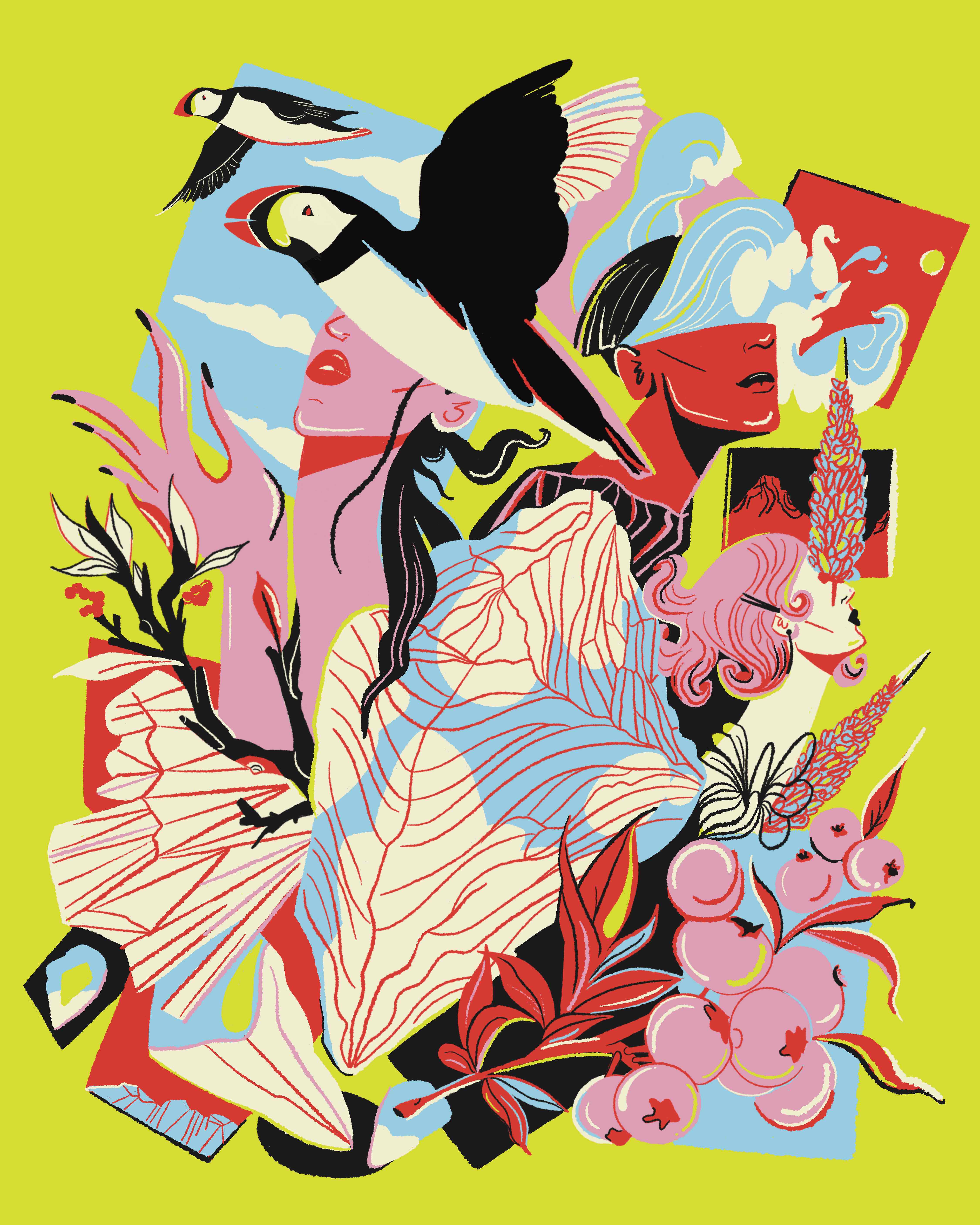
Read the inspiring stories about nature and climate written by children and youth. The young writers (11-18 years) are writing about their emotions, values and experiences related to the loss of nature and a changing climate.
The writing competition is supported by Sparebankstiftelsen DNBand organized by Climate Creativity. The stories are illustrated by artist Carolina Altavilla @caroaltavilla.
Tree, beach, nature, stick, water
Story by Freyja, Grøne Bråden barneskole
I love going to the beach, but I hate going home. I love hiking too, but I get so tired.
Nature. I love nature the most, it’s so much fun.
I found bark and a stone. Bark comes from a tree, and it needs water to live. And I found a stone from nature. A tree needs rain to live, not just sun. It can die from just having sun.
I drew a tree, because without trees, I wouldn’t be here. And I drew a sun, because I love when it’s summer.
Grandfather’s Snow Cave
Story by Natalie, Valdres vgs.
When I was little, I made snow caves in grandfather’s plowed snowbank every winter. He used the tractor to make big, white mountains of snow, and together we dug out caves with shovels and our hands. “The trick is to work with the snow, not against it,” he used to say with a sly smile as we shaped the entrance and smoothed the roof.
But now there isn’t as much snow. Some winters it comes late, other times it melts away before we manage to build anything. Grandfather says that when he was little, the snow lay a meter thick all winter, but now the mild weather comes more often. Still, we tried, even with thinner snowbanks and wetter snow.
It took time to get the cave big enough for us both to sit inside, but we worked patiently. Grandfather told stories about the cold winters he remembered, about how the snow creaked under his boots, and how people in the old days could build houses of snow that lasted the whole season. I found it strange to think about, knowing that our snow would soon melt.
Today I often look back on those moments with a smile, but also with a little unease. Grandfather’s method has stayed with me through life – take it step by step, find the right balance, and enjoy the process. But I wonder whether children in the future will get to experience the same thing.
Because a snow cave was never just a snow cave. It was a small structure of patience, love, and joy. And perhaps most importantly, a reminder that everything becomes easier when you stand together and keep each other warm – if only there is enough snow to build with.
The Farmyard Tree
Story by Vilde Synnøve Budeng-Larsen, Greveskogen vgs.
I eat and peer out of the kitchen window, down at our magnificent farmyard tree. I am sitting exactly as I did yesterday, and the day before that. The tree changes with the seasons, and with me. In May its leaves take on a strong color, just as my skin does. And in December all the leaves are gone, but the snow settles on the branches. That is how I feel in winter. I feel cold and sad, but friends, family, and the Christmas season wrap me up like snow.
After the winter holiday, when we return to our routines, we begin to catch the scent of spring. In March the sun rises at exactly the same time as I eat breakfast. At this time of year, the sun climbs up behind the trunk of the tree, and suddenly it peeks out at the top. I dig out my sunglasses for the first time that year, but I only wear them on top of my head because my hair looks so nice when the sunglasses pull it back.
When I wake up in April and go down to the kitchen, I am dazzled by the sun. I pull down the awning, but only just far enough that I can still see the tree and the flowers peeking up around the trunk on the ground. Wood anemones, buttercups, and fireweed. “Is it warm enough to go without a jacket today, Mum?” I hear my little brother shout up the stairs before he leaves. He grins from ear to ear after getting a yes and walks out the door to go to school. I sit in the kitchen and watch him as he passes by the window. The tree suddenly seemed a little bigger, a little brighter. I smile faintly, but not quite as wide as my little brother without his jacket.
I have had this view my whole life. Every day. If the tree is taken away from me, I will have to look down at the neighbor while I eat. I can no longer see how hard the wind blows on the leaves, or the lovely orange and red colors they take on in autumn. Then there will only be a stump standing there. Then that little stump will be all I have left. All we have left.
The River
Story by Knut Kroon, Valdres vgs.
Every Easter, Grandma and I went to the cabin. It was our place, filled with little traditions and good memories. We used to walk down to the small bridge that crossed the river with its gentle current. There we would throw a stick from one side and wait excitedly for it to come out again on the other. Sometimes it drifted straight through, other times it got stuck between rocks or at the edge. Either way, it was great fun.
But now the river is gone.
I remember the first time I came back and realized it. I stood on the bridge and looked down at the ground. The rocks the stick used to get stuck in were dry, and grass had begun to grow between them. The river had dried up over the years as I grew older. The climate had changed. Less snow in winter and warmer summers had caused our river to disappear.
It was strange and it felt empty. I had always thought of climate change as something big and distant – the ice melting in the Arctic or storms on the other side of the world. But here I stood, on the bridge Grandma and I used to play on. Here I stood, seeing the consequences right in front of me.
I could never again throw a stick from the bridge. Never again wait excitedly to see if it would come out. A part of my childhood was gone. But that strange feeling of emptiness also awakened a determination in me. I could not do anything about what had already happened, but perhaps there are more rivers like this, more places like this, that can still be saved.
Memories in the Forest
Story by Emilia Marie Montriou-Husum , Nadderud vgs.
As a child, I spent countless hours in the forest with my grandparents. At the same time every year, we went to our usual spots where the blueberry shrubs were overflowing. I remember the joy I felt as we filled up the buckets and the sun warmed my face. I looked forward so much to grandfather’s blueberry pie that we would eat that evening. Grandmother always told stories about how nature looked in her childhood. Lush, rich with birdsong, and with a fresh scent of moss and resin that I will never forget. It sounded so magical, energizing and timeless.
Last year I decided to take my best friend along the same route after many years’ break. By now I no longer had any grandparents to go with. I had looked forward to showing her all the forest’s secrets and feeling the same emotions from my childhood. But the forest was not the way I remembered it. The path was dry, the moss was brown, and the blueberry shrubs barely had any berries on them. What once felt unchanging now seemed worn and heavy.
We sat down on a tree stump and began to talk about what had happened. How climate change and human activity affect nature to such a great degree. For the first time, I felt a kind of guilt for not having taken more responsibility earlier. At the same time, I felt a strong will to do something now. Together, my friend and I decided to start doing small things in everyday life: buying secondhand, using less plastic, and getting involved in local environmental initiatives.
That day in the forest became a turning point for me. I realized how quickly the nature around us can change and how valuable nature really is. I decided that the tradition of caring for nature had to become just as important as picking berries in it.
Love for friends and family
Story by Emma Sofie, Grøne Bråden barneskole
I was with my mom. I brought hot cocoa, and I felt the cold wind blow on my face, and I wore warm and comfortable clothes. I was happy. I enjoyed myself. I wasn’t hot, but not cold either. I felt happy and lucky to have such a wonderful mom.
I drew a tree and a mountain.
I hope everyone in my family is healthy and that there won’t be a war.
My Story About Climate
Story by Andrii, Nadderud vgs.
I came to Norway from Ukraine because of the war. Life has changed a great deal, and it is not always easy to adapt to everything new. When people talk about climate change, I notice that it is not something I think much about right now. I have enough to deal with just managing everyday life and settling into a new country.
I know that climate change is important, and I see how it affects the world around us. For example, I hear about extreme weather such as heavy rainfall, drought, and heatwaves that destroy crops in many countries. Wildfires that spread quickly and the melting of the glaciers in the Arctic are also major concerns. Even here in Norway, I see that the winters are different – milder and with less snow than before, according to what people say.
I often hear about natural disasters, like hurricanes and floods, but it feels a little distant when you have other challenges to deal with. For me, it is mostly about making life work here and now.
Still, I try to do small things for the environment when I can – like sorting waste, using fewer plastic bags, or saving electricity by turning off the lights when I don’t need them. I know it is important to take care of the planet, even though I don’t feel climate change directly in my everyday life.
Maybe when things settle down for me, I can get more involved. For example, I could join local environmental groups, plant trees, or learn more about how I can contribute to sustainable development. Right now, I am focusing on building a future for myself here in Norway.
Galdhøpiggen Stands, the Glacier Disappears
Story by Maria Blankenborg Dalen, Valdres vgs.
I am standing on the summit of Galdhøpiggen, the same summit I stood on six years ago. As I look down at the Styggebreen glacier, I see how much it has melted since the first time I was there. The ice that once stretched far down the valley has retreated. What was once an unbroken white landscape is now marked by rock and gravel.
I remember the feeling of standing here for the first time. The strong wind against my cheek, the thin air, and how I had to fight my way up the final slope. The view was the reward; I was left speechless by the beautiful landscape around me. Now I stand here again, older, wiser, and more aware of the problem we are facing. The mountain hike is still the same, but the landscape has changed, and so has my experience.
Nature is constantly changing, just like we humans. These mountains once seemed eternal, but now I clearly see how fragile the mountains and nature really are. The Styggebreen glacier is melting faster than I could have imagined. What took thousands of years to build up is disappearing in just a few decades. It almost feels as if the mountain is losing part of its identity, just as we humans do when time takes from us what we once were.
I feel a sorrow and unease for nature. It is a strange feeling. To witness something so vast, yet still feel so small. At the same time, I feel a deep gratitude. For being allowed to be here. For getting to see this with my own eyes, to feel the wind against my cheek and hear the silence that exists only in places like this. I promise myself to remember this moment, to carry the respect for nature with me. All of this with a modest hope that the Styggebreen glacier will be there the next time I come, a hope that my descendants will get to experience this mighty glacier.
Tears of Hope
Story by Hamdi Shafi Ainab, Nadderud vgs.
I remember the smell of dust in the air; as a child in Somalia, I saw the earth crack open beneath our feet. The water in the well dried up, and our village fell silent. The mothers gathered their children around them, and the fathers walked long distances to find something, anything, that could give us hope.
Once, when I was little, the rain came. We ran outside, happy that the drought was finally over. But the joy was short-lived. The rain fell like a wave of wrath, and everything we owned vanished in the water. Our houses, the fields, the dreams – everything was washed away. I remember the sound of crying around me, but also the strong gaze of my mother, who never stopped believing in a better future.
Now, as an adult, I often think about that time. I think about how many are still fighting the same battle, where the climate is not just weather, but an enemy that takes everything. I reflect on how unfair it is that those who have the least suffer the most.
But I also dream. I dream of a Somalia where children can play without fearing drought or flood. I dream of a world that takes responsibility, a world where we all work to stop climate change, to give hope to those who need it most.
My memory of my country is both a sorrow and a strength. It reminds me that we must act now, for we have only one Earth, and we must take care of it, for ourselves and for one another. And instead of waiting for the world’s leaders to begin the journey of change, we must take our own part of the change seriously.
A Dying Earth
Story by Boipelo, Nadderud vgs.
What is a country with dirty air and soil, dead and rotting trees, land animals and sea animals? This is the Earth we come closer to every day. We deliberately take more than we need from the Earth. We take animals from their land and homes only to put them in a cage and watch them like TV. Companies worth millions deliberately cause destruction, and we, ordinary people, buy from and support them because that is what society has become.
Humans do not only harm animals, we harm each other. We exploit one another to save money; we manipulate and kill each other. Two people of the same age can live opposite lives. One may have many cars and houses while the other lives in a box of paper. Why? Why have we taken a beautiful place and turned it into a war zone? Why have we taken animals that never did anything to us and made them rare?
The Earth has given us food with all the vitamins and minerals we need, water, beautiful places, and our job was simply to take good care of it. But instead, we have destroyed it. I want to work with animals and plants as an ecologist, but if humans continue to be harmful, there may not even be living and thriving ecosystems to work with in the future. What kind of world have we created, where there is inequality, multiple forms of pollution, worsening storms, and some of the most extreme weather ever recorded?
Is this the world you want future generations to live in? If not, then we can make a change. We have everything we need, but we take it for granted.